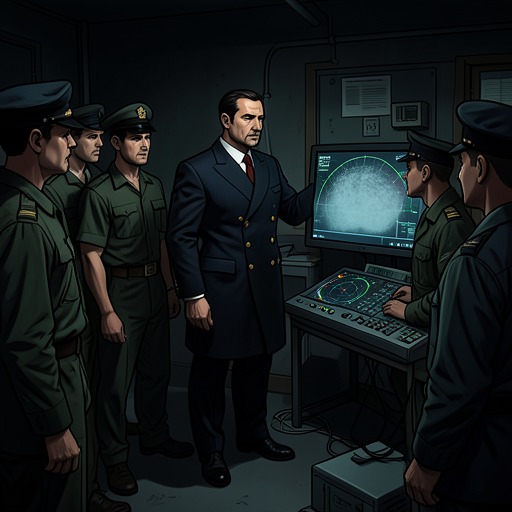
Keeling pursues and attacks the U-boat that releases a decoy
The Good ShepherdKrause’s pursuit of a U-boat that releases a Pillenwerfer turns on a hard-won distinction between a real target and a convincing false contact. Keeling chases the bubbles, loses the sonar trace, and then finds the submarine again; Krause attacks with a deliberately close, shallow pattern but cannot establish that the U-boat has been destroyed. With the convoy still under threat, he ultimately orders Keeling back to the fighting rather than spend more time on an uncertain result.
The Pursuit and the False Contact
The chase resumes with reports of pips astern: bearing 005, range 2,000. Krause recognizes the contact as probably the submarine Keeling had attacked earlier. It has already endured gunfire and depth charges, yet appears to have surfaced and to be hurrying to overtake the convoy again. He orders a turn toward it as reports place the target on an easterly course. The encounter is not a clean pursuit of a continuously visible vessel: its bearing shifts, and the sonar picture will soon become deceptive.
The submarine’s apparent disappearance initially leaves room for competing explanations. Krause considers whether it might be hanging motionless in a cold layer of water, but the next report is no contact. That absence hardens his suspicion: Keeling has been following a Pillenwerfer, a device emitting bubbles that imitate a target on sonar, while the U-boat escapes. The realization carries a specific operational cost. Had the bubbles continued for another five minutes, Krause might have attacked the false contact and circled back to attack it again, wasting both ammunition and time. His suspicion had not become strong enough before the trace vanished to prevent that mistake.
Finding the Submarine Again
Krause turns to locate the convoy, then receives a new sequence of bearings and ranges. At 7,800 yards, the changing bearing suggests that the U-boat is crossing Keeling’s bows, once more trying to get ahead of the convoy. Krause reasons that the submarine must have altered course about twelve points to starboard after releasing its decoy, and surfaced again when it believed the danger had passed. It is four miles away. The false contact has not ended the pursuit; it has forced him to decide how to resume it without giving the submarine another safe chance to dive.
He considers approaching the U-boat’s port bow as before, but the submarine has already sighted Keeling in time to submerge. A rear approach might exploit a less effective lookout aft, although letting the U-boat get between Keeling and the convoy carries its own danger. Krause shuts his eyes while he works through the changing bearings and ranges, concentrating on the interception problem. He could ask the officers below to calculate it, but first he would have to explain his thinking, costing time and risking misunderstanding. When the next report arrives, he has made his decision: he will let the submarine get a little farther ahead of the safety area and approach from behind.
A Close, Shallow Attack
Krause orders a close pattern with a shallow setting. The instructions express the wager behind his attack: a submarine surprised on the surface would probably dive as fast as it could, but might not have time to get deep. A deep setting could send the charges harmlessly below it; Krause wants them to explode close alongside. The choice is not a mechanical solution to the problem. It depends on judging how quickly the U-boat can react and where it will be when the charges reach it.
As Keeling closes, the submarine appears on a wave-top in the dark. Krause steers to meet it; the vessel appears again, then seems to vanish as Keeling hurtles toward the point where it was last seen. With Sand beside him, Krause orders the attack: the two torpedoes—reported as targets in the scene—and the K-guns are followed by standard-speed engines and a turn to starboard. Depth charges explode astern in the tossing sea. The encounter is measured in seconds and shifting glimpses, not a stable view of the target, and the explosions do not immediately settle whether the submarine has been hit.
Keeling circles and attacks again, waiting after the last explosion before making another run. Sand fires a further pair of charges, and Krause orders another pattern. The repeated ellipses of explosions show how much of the engagement consists of acting without knowing the enemy captain’s next move. Krause has studied anti-submarine warfare at Casco Bay and read classified accounts of British experience, while mathematicians and instrument-makers have worked to improve the odds of detecting and striking a submerged U-boat. None of that knowledge can reveal whether its captain will turn to port or starboard, or dive deep or remain shallow. The destroyer’s attack still depends on a commander’s patience, persistence, and judgment under uncertainty.
Uncertain Damage and the Return to the Convoy
Oil might indicate that the submarine has been hit; a large spreading slick would be close to proof of destruction. Sand thinks he can smell it, but Krause cannot confidently detect it. He refuses to turn that uncertain impression into a claim for his report. The possibility nevertheless matters to his next decision: the U-boat is below the surface and may remain there for some time, and it is probably far enough astern not to threaten the convoy immediately.
Krause weighs that possibility against the continuing danger to the ships ahead. The other three escort vessels are already engaged in the struggle, and Keeling can do more for the convoy by returning to them than by remaining astern in search of confirmation. His order to leave is presented as a decision, not an invitation to debate. He gives Carling the conn and directs him to take Keeling around the convoy’s left flank at the best practicable speed. The pursuit therefore ends without a confirmed sinking: its immediate result is an uncertainly damaged or possibly sunk U-boat, while its definite consequence is Keeling’s return toward the convoy’s still-unfinished fight.